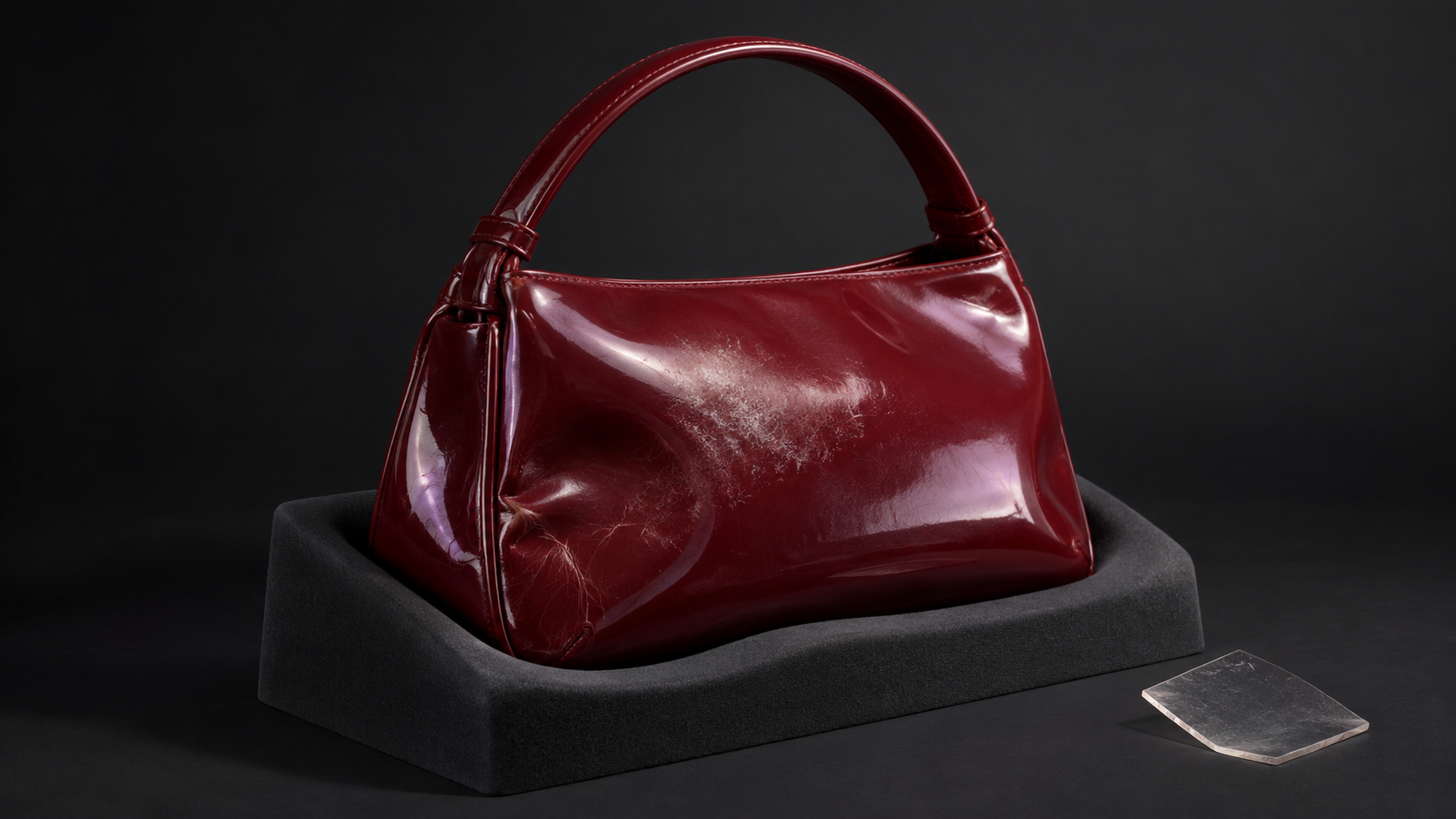
A plastic handbag that becomes sticky is an awkward museum object. The surface that once made it fashionable may now attract dust, transfer material, or resist safe handling. The temptation is to clean it until it looks presentable again. But a sticky surface can be evidence of chemical change within the object. Removing what has appeared on the outside may be a treatment with consequences, not ordinary housekeeping.
Plastic conservation is interesting precisely because it disrupts our habits of respect. We readily imagine a fragile manuscript deserving patience. A deteriorating synthetic accessory can look like something that should have been discarded years ago. Yet if it holds evidence of design, manufacturing, or use, throwing it away because it no longer behaves as expected merely repeats the hierarchy that made its history easy to overlook.
The material name is only the beginning
The Canadian Conservation Institute explains that plastic objects contain base polymers plus additives that alter properties. Objects made from the same general polymer can therefore behave differently. Its guidance identifies several especially troublesome groups and emphasizes material identification before choosing preventive care. The institute's account of plastics and rubbers also describes how degradation products can affect neighboring collection materials.
This is why “made of plastic” is such an inadequate catalog description. It names a broad family while concealing distinctions that can determine an object's future. Flexibility, color, transparency, and manufacturing history are not merely stylistic features; they may also be clues to composition and vulnerability.
Nor is resistance to complete environmental decomposition the same as stability as a museum object. A material can persist while losing the shape, surface, or strength that made it culturally legible. There is no contradiction between a plastic waste problem and a plastic artifact that crumbles. The two questions use different definitions of survival.
The surface may be a symptom
Getty's account of the InBloom project describes white crystalline deposits on thermoplastic-polyurethane-coated fabrics. The project investigates their composition, effects, and the implications of removing or retaining them. Its report distinguishes established findings from research questions still under investigation. The account of conserving synthetic fashion does not offer a settled treatment recipe for every instance of blooming.
That uncertainty deserves protection from the desire for a satisfying transformation. A before-and-after photograph can show that a deposit is gone. It cannot alone show whether the cleaning improved long-term stability, altered the coating, or removed useful evidence about the process. Appearance is one outcome among several that a treatment has to consider.
The question also has a curatorial dimension. A glossy garment was made to look glossy. Its altered surface can prevent a viewer from understanding that effect. Leaving every change untouched is therefore not automatically more faithful to the object. The challenge is to understand what can be recovered, what would be sacrificed, and which uncertainty remains.
Making new plastic to understand old plastic
Getty conservation scientists have reproduced historical cellulose-acetate formulations and made standardized test shapes to study aging and mechanical behavior. The same institutional account describes the importance of additives and the challenges of repairing transparent plastics. The laboratory's explanation of this research shows why manufacturing knowledge belongs in conservation science.
A reference sample offers something a unique artifact cannot: permission to test a hypothesis systematically. Researchers can vary a formulation or expose comparable pieces to different conditions. The experiment does not reproduce every event in an old object's life, but it can help separate questions that would otherwise remain tangled together.
The distinction between a test piece and a collection object is important. An old handbag brings unknown storage conditions, earlier treatments, use, and perhaps an undocumented formulation. A promising result on a model needs interpretation before it becomes an intervention on that bag. Laboratory control is powerful because it narrows a question, not because it eliminates the difference between model and history.
A cleaner surface needs a better test
At the V&A, Mark Kearney revisited methods used to assess cleaning of plastics. His account describes work to reduce subjectivity and improve reproducibility, including standardized droplets and photographic measurement of contact angles. The aim was to develop assessments usable by bench conservators with accessible equipment. The V&A's account of the cleaning experiments offers an unusually concrete example of method improvement.
This kind of work rarely gets the attention given to a spectacular restored object. Yet it changes how confident a treatment recommendation can be. If different operators interpret a surface differently, an apparent success may be difficult to reproduce. Better measurements do not replace judgment; they give judgment something more stable to work with.
There is an institutional point here as well. A method that requires equipment unavailable to most collections may remain valuable, but it solves a narrower practical problem. Research that also considers cost, training, and repeatability addresses the circumstances in which conservation actually happens.
Keeping the ordinary requires selective care
Preserving a synthetic accessory is not an endorsement of disposable consumption. It can help document the material choices that shaped that consumption: the imitation of leather, the appeal of transparency, the promise of easy care. Those histories become harder to study if only objects made from traditionally prestigious materials receive patient attention.
That does not mean saving every plastic object forever. It means making selection and treatment decisions with knowledge rather than distaste. A sticky bag may be significant because of a documented design, a particular technique, or its relationship to a collection. Its deterioration is then a problem to investigate, not proof that the original decision to collect it was absurd.
The strongest case for keeping it is modest. The object can still tell us something, and its future may improve if we learn how it is changing. A museum's willingness to slow down before wiping it clean is a way of taking that evidence seriously. The work begins when an unattractive surface becomes a question.
A thought worth keeping?