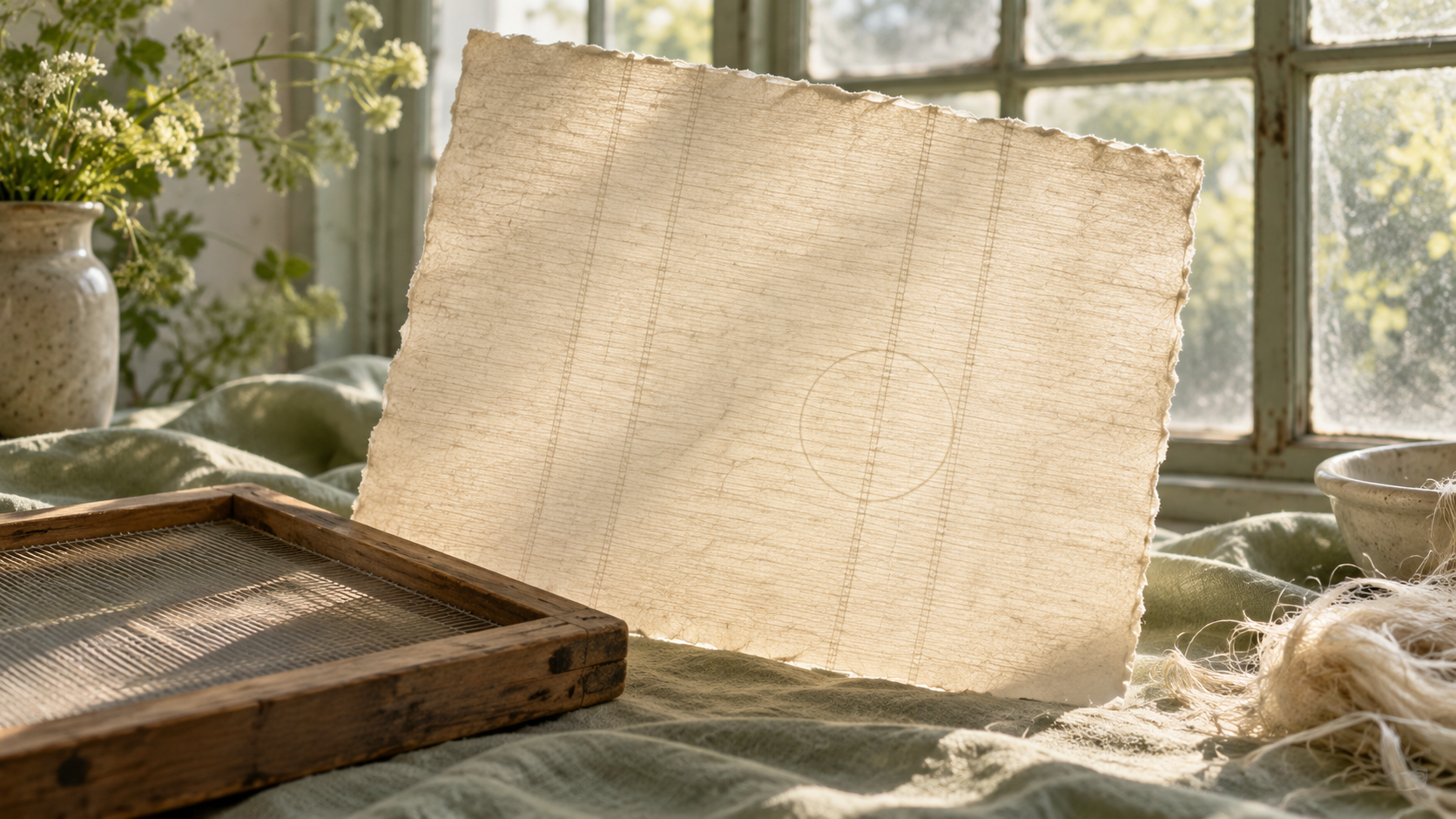
A page without writing is not a page without evidence. Hold some handmade papers to transmitted light and the sheet reveals the structure of the mould that formed it: close lines, more widely spaced supporting lines, perhaps a watermark. The marks are not decorations added after manufacture. They are differences in the sheet itself. The support carrying a text can also carry a record of its own production.
That makes historical paper a useful test of our attention. We are trained to treat it as a transparent route to words, drawings, or music. Looking at the sheet as a made object brings other people and other kinds of work into view. It also makes the attractive phrase “paper never forgets” look too easy. Paper retains clues, but clues still require interpretation.
Clothing enters the library
A Library of Congress account of European hand papermaking follows rags through sorting, cleaning, pulping, sheet forming, pressing, drying, and sizing. It uses historical images and objects from the collection to explain a labor-intensive process. Linen and other suitable cloth provided a material source for paper long before the page reached a printer or writer. The Library's papermaking account places the sheet within a chain of collection and skilled work.
This history suggests a productive reversal of the usual view of a book. A printed volume is not simply an author's words made material at the press. Its paper arrives with a prior history of fiber processing and manufacture. The intellectual object depends on an economy of worn materials and people whose names seldom appear on the title page.
Recycling, however, is too broad a label to explain the craft. Rags were not interchangeable waste. Their condition mattered, as did the labor of selecting and preparing them. The fact that a valuable sheet began with used cloth should not make its manufacture sound effortless or inevitable.
The limits of a beautiful reconstruction
Timothy Barrett's detailed account of European papermaking from 1300 to 1800 is unusually candid about its limitations. He combines historical descriptions, research, and practical knowledge, but warns that local methods varied and that parts of the reconstruction remain hypothetical. His discussion also connects paper properties with fiber preparation, water, and sizing. Barrett's essay at the University of Iowa is a model of explaining a process without pretending every mill followed one recipe.
That caution matters because process diagrams are persuasive. A row of stages can turn a historically variable practice into something that resembles a standardized factory procedure. The diagram may be useful, but its clarity should not erase variation in raw materials, local water, tools, or judgment.
The same restraint applies to surviving paper. One robust old sheet does not prove that all old paper was superior, nor that every later paper was poor. A collection gives us selected survivors. To compare periods responsibly, we need more than the satisfaction of finding a centuries-old page still pleasant to turn.
Barrett's introduction provides a broader principle: practical reconstruction can generate good hypotheses while remaining distinguishable from direct historical observation. Knowing how a sheet might have been made is valuable. Knowing how securely that account applies to a particular sheet is a separate task.
A watermark is a relationship, not a date stamp
The British Library's account of watermark documentation explains how wires attached to a papermaking mould create thinner regions in a sheet. Design, placement, chain-line spacing, and countermarks can all aid comparison. A recent project contributed traced and photographed watermarks from India Office Records to the Bernstein portal, expanding the material available for researchers to compare. The Library's description of the project is grounded in specific collection work.
The crucial word is comparison. A watermark is not automatically a precise date for the text written on the paper. The mark relates to manufacture; writing and later use introduce other events. As an inference from that distinction, paper could remain unused before it received text, and a document could travel after it was written. A responsible argument has to keep those possibilities separate.
Even a striking visual resemblance should begin a line of inquiry rather than end one. Which features match? Are scale and orientation recorded? What other characteristics of the sheet support the proposed connection? The detective-story pleasure becomes more durable when a reader can see the intermediate steps.
Light changes the question
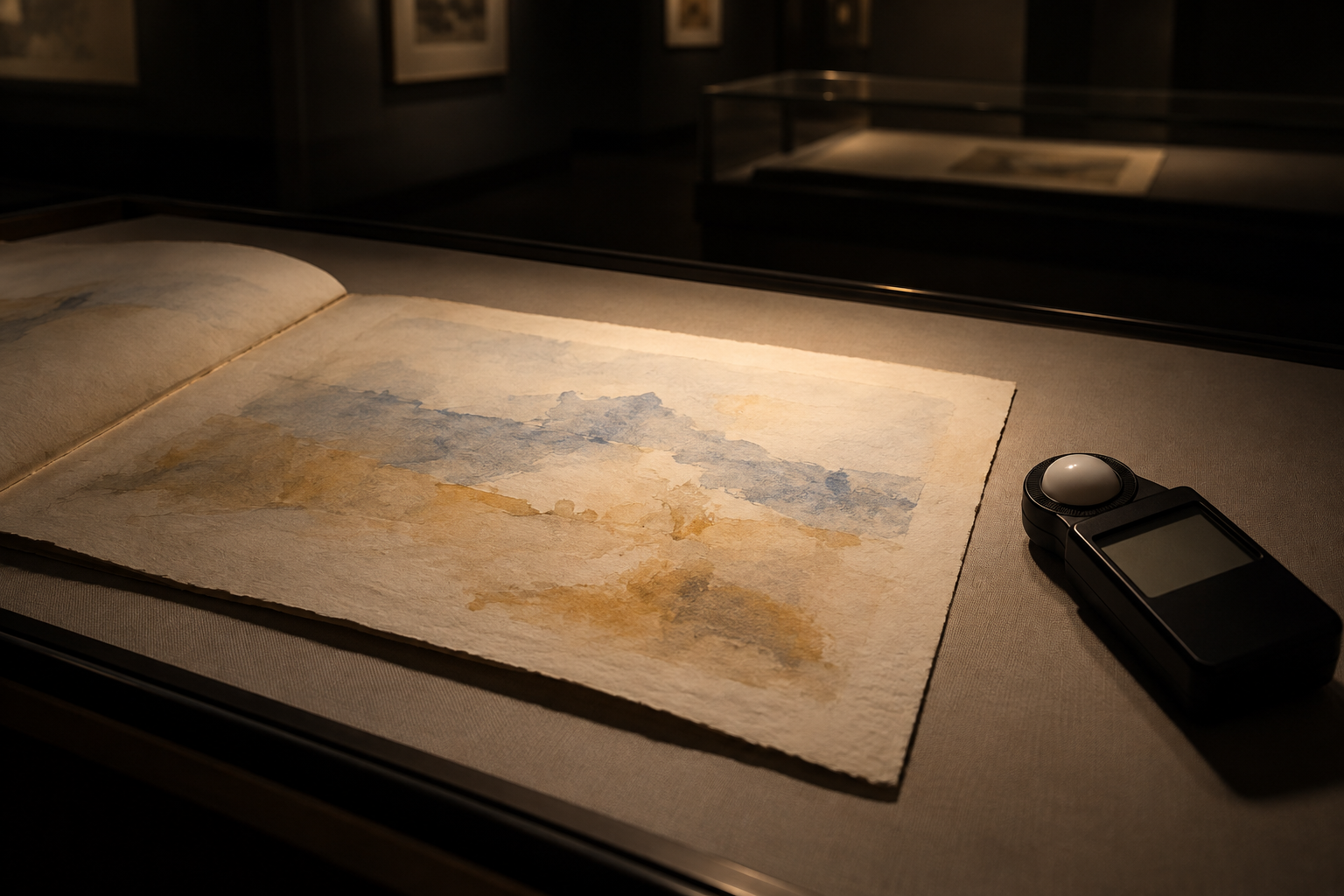
Conservation photography at the Library of Congress uses different lighting conditions for different purposes. Transmitted illumination emphasizes thickness variations, including watermarks and repairs; raking light records surface characteristics; other modes help distinguish materials. Images made before and after treatment under consistent conditions support comparison. The Library's explanation of conservation photodocumentation shows why one attractive photograph cannot document every aspect of a sheet.
A front-lit scan may be excellent for reading ink while concealing features made clearer by light passing through the paper. That is not a failure of the scan. It is a reminder that every image is an answer to a chosen question. A digital facsimile can preserve readability without exhausting the object's material evidence.
This should make us curious about blank margins and blank leaves. They can carry manufacturing features, traces of use, and information about binding or repair. Their lack of text is not evidence that they are expendable. The physical book's structure may be legible precisely where the author has said nothing.
A slower account of the page
Reading paper as evidence does not require replacing literary interpretation with technical analysis. It enlarges the field of attention. A poem can remain a poem while its sheet offers another history of labor, trade, reuse, and treatment. The two histories may intersect without collapsing into a single explanation.
The reward is a less lonely conception of cultural production. A printed author has a name; a rag sorter or vat worker often does not. The sheet gives us a way to recognize the work without inventing biographies for unknown people. We can describe the process, acknowledge uncertainty, and let the surviving material set the limits.
A blank page is therefore neither mute nor infinitely eloquent. It holds particular traces made under particular conditions. Asking what those traces can support—and what they cannot—is the difference between appreciating historical paper as a handsome surface and reading it as a historical object.
A thought worth keeping?