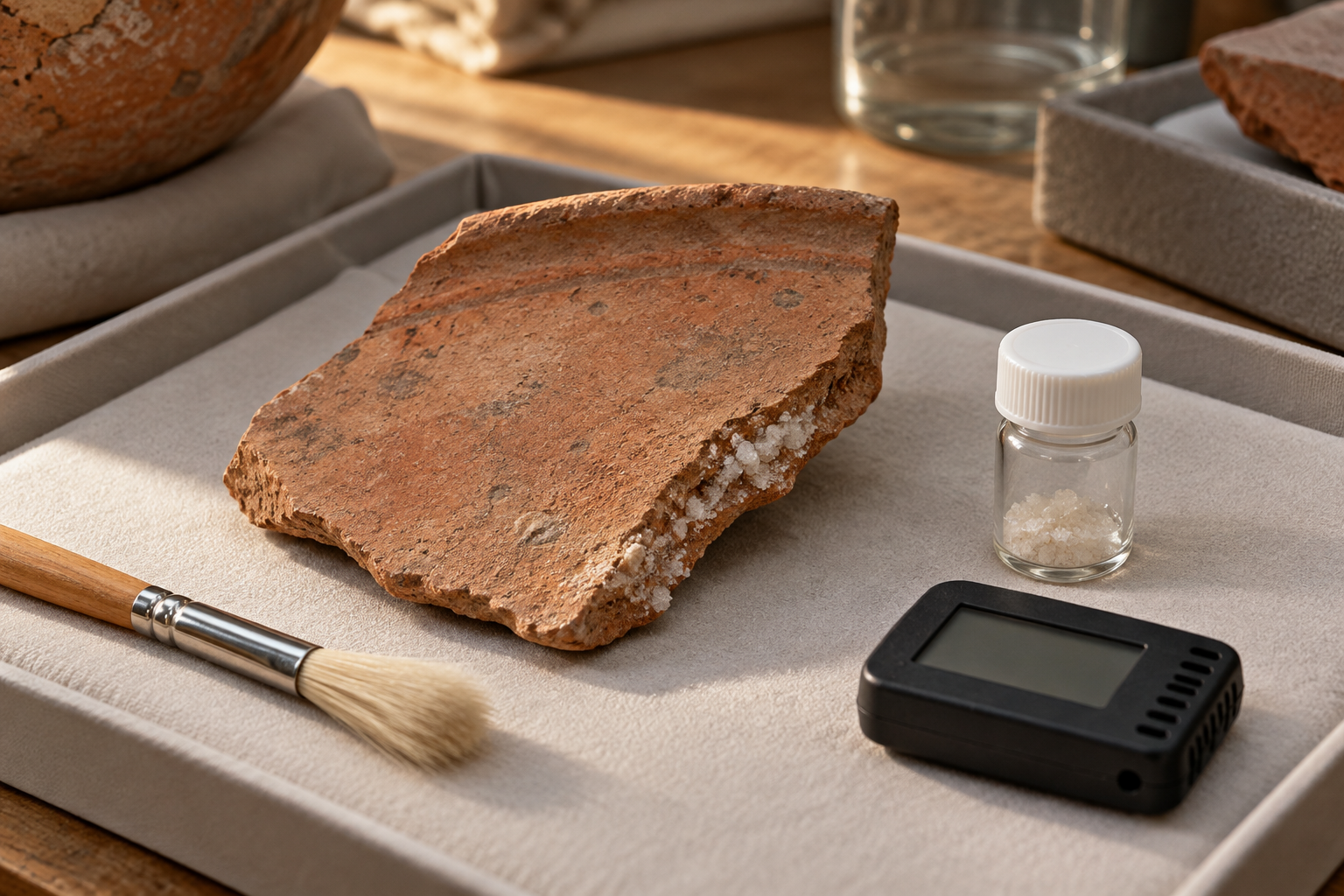
A pot can leave wet ground looking intact and start to shed its surface on a museum shelf. A pale bloom may appear along a break. A painted or glazed patch may lift. The trouble can have travelled in with the object, dissolved in the water that filled its pores. When that water leaves, soluble salts crystallize inside the clay. Later changes in humidity can dissolve and crystallize them again. The Society for Historical Archaeology's conservation guidance describes why this is especially dangerous for porous, low-fired ceramics: growing crystals can press against a weak body or a harder surface layer.
The visible powder is a clue, not a full diagnosis. Salts can arrive from groundwater, seawater or the object's surroundings after excavation; not every pale deposit behaves the same way. The society's guide to initial processing distinguishes soluble salts from less soluble surface deposits and notes that damage can show up immediately or after years in storage. It advises keeping porous ceramics from wet contexts from drying before their salt content is assessed. That is a decision about timing as much as treatment: once the object has dried and begun to flake, the evidence and the choices available to a conservator have changed.
The clay itself makes the problem uneven. The size and connections of its pores, how thoroughly it was fired, and whether glaze or slip covers part of it affect where water enters and leaves. A glaze can look like a protective skin while salts collect below it. In experiments on antique Dutch ceramic tiles, researchers used imaging to watch sodium chloride and sodium sulfate follow different paths during wetting and drying. In their samples, sulfate accumulated near the glaze-body interface at corners where evaporation was greatest, and cracking could run through both layers. Those findings describe the tested tiles and salts; they are not a diagram for every buried pot. They show why the surface can conceal the place where damage begins.
The bath has to answer to the object
Water can draw soluble salts out of a ceramic. A conservator may place a suitable object in repeated baths of good-quality water and measure what the baths take up. But water can also soften a poorly fired body, disturb a fragile glaze, erase a trace of use, or move an inscription. The initial-processing guide cautions against routine desalination without a reason and says some poorly fired ceramics should not be immersed at all. It also asks excavators to preserve the contents of a complete vessel for separate study. Cleaning a pot is not merely a matter of making its surface look clean.
The measurement is modest but useful. As salts leave the object and enter a bath, the water conducts electricity more readily. Repeated conductivity readings can show the direction of change and help decide when further washing offers little benefit. In a 1993 instrument comparison, Werner Zimmt and Nancy Odegaard tested a laboratory meter and portable testers with prepared salt solutions. They found the portable instruments useful for following salt removal, while noting their narrower range and lower sensitivity at the clean-water end. A conductivity reading does not tell the conservator which salts are present. Nor is a low reading proof that every pore has been emptied.
A study of terra-cotta bangle fragments from Harappa makes the endpoint less abstract. The site's soil and available water were salty, while distilling enough clean water for large numbers of finds consumed scarce resources. Researchers treated pieces to different final bath readings and compared them with untreated controls. Salt crystals remained even in samples washed to the lowest detectable reading. In their preliminary aging tests, damage appeared in the untreated controls while the partly desalinated samples remained visibly stable. The authors did not declare a safe universal salt level. They said the longer study was needed to learn how much could remain under Harappa's actual storage conditions. “More washing” was an expense and a possible material risk, not a substitute for that evidence.
An inscribed object puts the trade-off in sharper relief. Conservators Vanessa Muros and John Hirx reported on an Egyptian ostracon, a written ceramic fragment whose salts were damaging a powdery surface. Ordinary immersion threatened the ink and loose flakes. They tested a detached speck of ink, protected the inscription with a temporary barrier, and drew salts through a damp poultice placed against the back. Over two months they changed the poultice and monitored the conductivity of water used to wash it, then let the fragment dry slowly. The inscription survived, but two tiny surface flakes were lost. Their experimental conclusion was deliberately limited: the barrier had protected slightly water-sensitive test ink better than very water-sensitive ink. The successful case was not a license to use the same method on any marked sherd.
Treatment also does not end when the last bath is poured away. Some salt can remain in inaccessible pores, and changing humidity can make it move again. The Canadian Conservation Institute's collection guidance recommends stable relative humidity for ceramics suspected of containing salts, with only small fluctuations, especially toward the humid end. The Harappa pilot study likewise treated storage conditions as part of the question of how much salt might safely remain. A dry, stable room does not cure an unstable pot, but it can keep a susceptible material from repeatedly crossing conditions that trigger dissolution and crystallization.
The conservation decision is therefore a sequence of specific questions. Where did this object get wet? Is its fabric strong enough to tolerate water now? Does its surface hold paint, writing, glaze or residues that washing would remove? What do tests show is leaving it, and what remains uncertain? A pot's salt may be hidden, but its treatment should not be. The record of tests, baths, losses and storage conditions becomes part of how future caretakers understand what they have inherited.
A thought worth keeping?