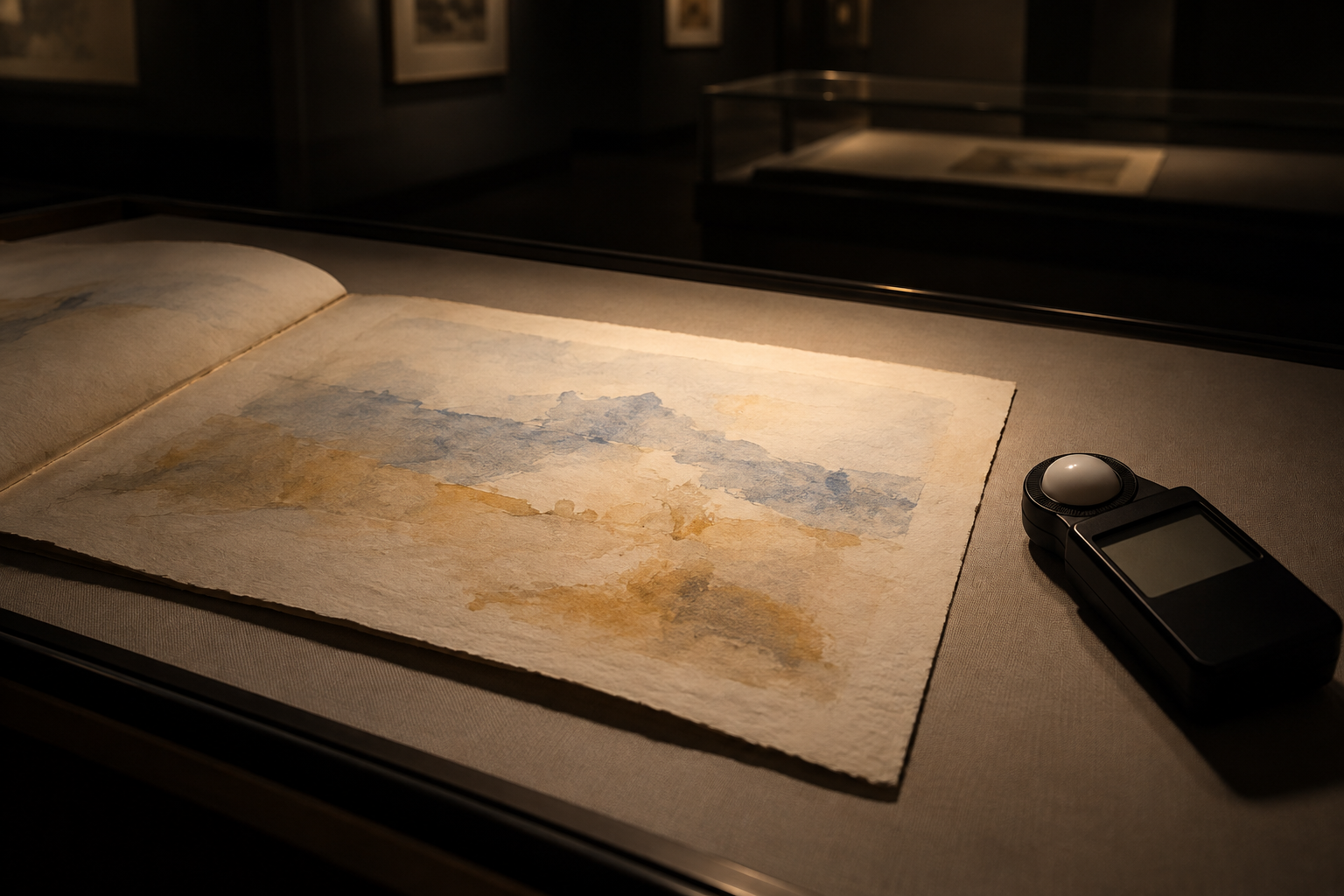
A light meter can be a strange companion to a drawing. In the Metropolitan Museum of Art's handling guide, a photograph shows the meter held parallel to a work on paper, so its sensor receives light much as the paper does. The guide sets a ceiling of five foot-candles for display and limits a display period to three months. It then asks a harder question: how often can this sheet return to view? That decision, it says, belongs to the individual object. The meter gives a reading for the present moment; a conservation decision must account for the object's future as well. The Met's guide
The number on the meter is an illuminance reading: the amount of visible light falling on a surface, usually expressed in lux. Five foot-candles is about 54 lux. It tells the conservator whether a lamp, case or patch of daylight is delivering the intended level at the page, rather than merely looking dim from the aisle. But the reading does not say how long the lamp stays on. The Canadian Conservation Institute describes light exposure as illuminance multiplied by time. At a steady 50 lux, 1,000 hours would add 50,000 lux-hours to an object's exposure history. That arithmetic is an illustration of dose, not a universal allowance or a promise that damage begins after some fixed total. CCI on measuring light
A dim lamp still has a clock
Light damage accumulates. A page under a low lamp for many hours may receive a comparable visible-light dose to one under a brighter lamp for fewer hours. The Library of Congress describes this as a reciprocity principle and urges institutions to record both the light level and the duration. The comparison helps plan exhibitions, though the spectrum of the light and the materials on the page still matter. The same guide notes that fading, yellowing and embrittlement can change an object as evidence as well as an image. Once the chemistry has changed, returning the page to a dark box does not restore the lost color. Library of Congress guidance
This makes rotation more than a device for refreshing a gallery. The Met's three-month display period is part of its own guidance for works on paper; it also calls for case-by-case decisions about how frequently a work returns. A sheet moved into dark storage stops receiving exhibition light, but its earlier exposure remains in its history. Work awaiting installation, framed drawings in a storeroom and pages being examined in a study room can all receive light outside the public exhibition. The Met recommends covering vulnerable works when they are not actively studied and lowering or switching off storage-area lights when staff leave. The Met's guide
The page has more than one material
A work on paper may combine a sheet, one or several inks, watercolor washes, pencil and later repairs. It is tempting to assign the whole object a single level of tolerance. The Canadian Conservation Institute's paper guidance shows why that shortcut fails. It classifies many felt-tip colors, historical dyes and some ballpoint inks among highly light-sensitive materials. Charcoal and graphite themselves are far more stable in visible light, yet the paper beneath them can still change. Watercolor's thin washes make even a small loss of color conspicuous. The relevant question is therefore not simply “Is it paper?” but “Which visible part could change first, and how would that change affect the work?” CCI guidance for paper objects
General categories offer a starting point, not a test of an individual artifact. CCI's older guidance on storing works on paper recommends 50 lux or less for sensitive watercolors, colored prints and poor-quality paper, and permits higher levels for some stable carbon ink on good paper. The contrast reflects different materials and conditions; it should not be read as two guaranteed safe settings. CCI's more detailed paper guidance warns that highly sensitive colors can fade even at 50 lux with ultraviolet radiation removed if they remain on continuous display for years. Limiting time is as important as setting the lamp. CCI storage note · CCI paper guidance
Filtering ultraviolet radiation is useful. The Met recommends ultraviolet-filtering glazing and appropriate lighting, and the Library of Congress advises controlling ultraviolet and heat. Yet a good filter does not make the visible beam harmless. We need visible light to see the drawing; some colorants react to that same part of the spectrum. CCI's comparisons show that lowering visible light can make a much larger difference to a vulnerable color than removing ultraviolet radiation alone. A curator who reports “UV filtered” has described one protection, not the whole exposure plan. The Met's guide · Library of Congress guidance · CCI paper guidance
When the material can be tested
For some works, conservators can investigate the actual colorants rather than rely only on a category. Microfading testing directs a small, controlled exposure at a minute area and measures whether its color changes. The Getty Conservation Institute describes the method as a way to assess an object's light sensitivity before planning display, while noting that a substitute sample may not behave exactly like the work itself. The test provides evidence for an exhibition decision, not immunity from damage. Getty Conservation Institute
One study at the National Museum in Kraków tested six framed pastels by Stanisław Wyspiański. The researchers found especially sensitive orange and pink areas, comparable in their test to low-number Blue Wool standards, and reported that the gap between glazing and object mattered for reliable measurements through the glass. Those findings concern six particular works and the method used to examine them. They do not establish a single display limit for every pastel, but they show why a material label alone can conceal the vulnerability of a particular color. The 2018 study
The remaining decision is partly editorial. A rare page may need to be seen in its original form for a short exhibition; a facsimile may carry much of the explanation during a longer display. A study room can uncover evidence that no reproduction resolves, while a cover over the page between consultations saves exposure that serves no reader. The Library of Congress acknowledges that access can sometimes warrant a documented departure from general display guidance. That admission does not weaken the measurement. It explains why the record matters: the museum can say what it exposed, for how long, and in service of what kind of access. Library of Congress guidance
The light meter's small reading is valuable precisely because it is incomplete. It fixes one part of a decision that also needs a clock, knowledge of the page's materials and a memory of its earlier outings. A museum cannot show a sheet without spending some of its capacity to remain as it is. Measuring that expenditure makes the choice visible before the color change is.
A thought worth keeping?