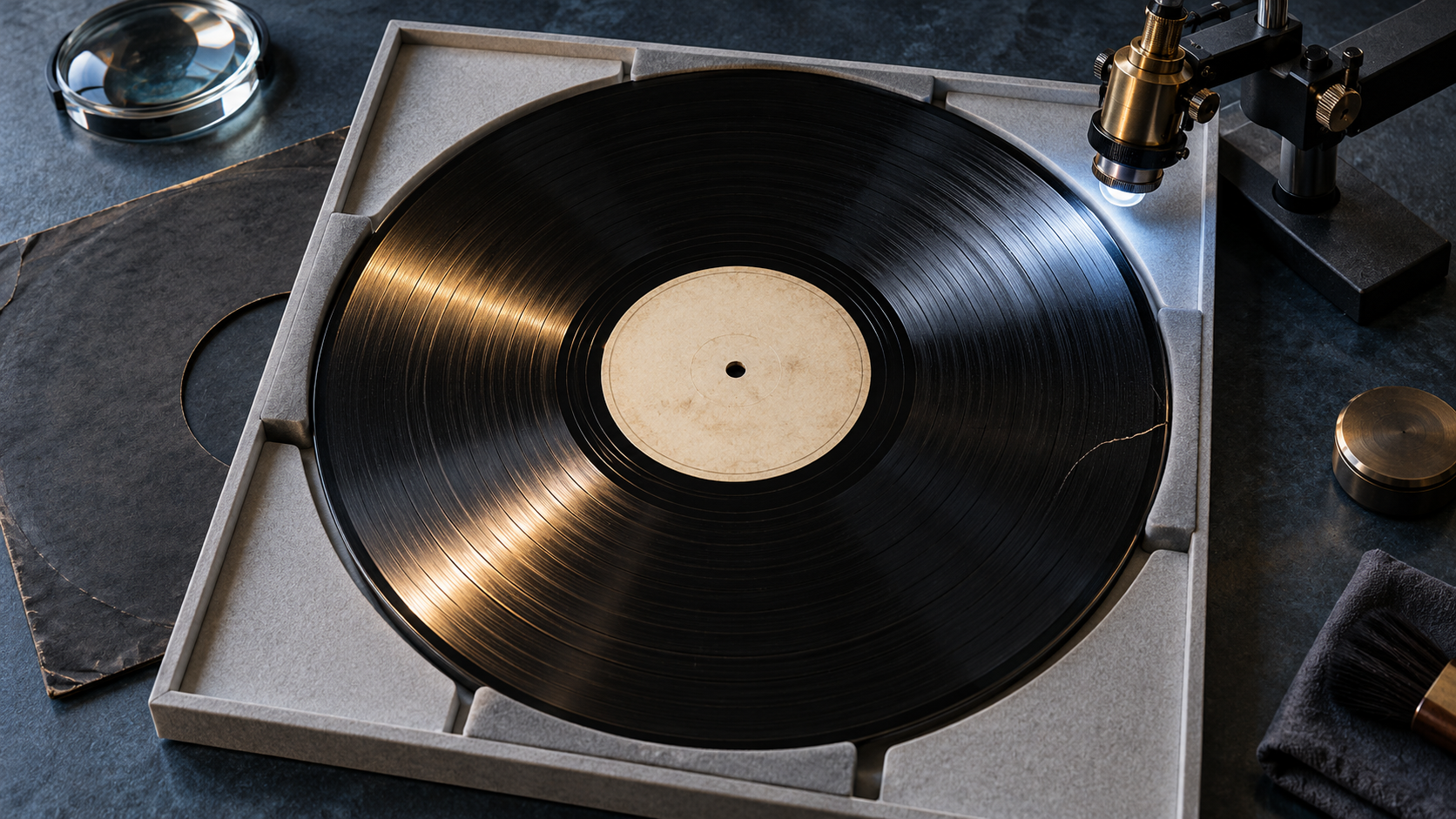
A broken disc presents a peculiar conservation problem. You can preserve its pieces beautifully and still be unable to hear what they contain. A sound recording is both an object and an instruction to a machine. Its survival depends on the material carrying the signal, the equipment interpreting it, and the decisions of the person making the transfer. Keeping only the first part does not preserve the whole encounter.
This is why recorded sound complicates the comforting distinction between an authentic original and a convenient copy. Sometimes a carefully documented copy is what allows the original's most important property to remain available. The Library of Congress's accounts of lacquer-disc work show how much judgment sits inside that apparently straightforward act.
The sleeve belongs in the story
A 2023 Library interview describes the processing of large lacquer discs from the Universal Music Group collection, many dating from the 1930s through the 1950s. Staff recorded matrix numbers, artists, titles, tracks, and inscriptions from discs and sleeves, then rehoused the discs. Damaged examples received protective housing before transfer work. The account also explains that these lacquers could serve in the production chain leading to commercial pressings. Hannah Whitaker's description of the project makes cataloging and physical care inseparable.
The sleeve is easy to underestimate because it does not produce sound. Yet a note can identify a take, connect a fragment to a performer, or preserve a distinction the grooves alone cannot explain. Separating signal from context too aggressively could produce an immaculate file that nobody knows how to use.
That is not an argument for preserving every container in its original physical relationship regardless of damage. It is an argument for recording relationships before changing them. A safer enclosure and an accurate account of the old one can cooperate. Storage improvements should not silently erase the evidence that made an otherwise anonymous sound intelligible.
A transfer has an author, even when it tries to be neutral
Audio preservation specialist Rob Cristarella describes selecting playback speed and stylus size for historical discs, monitoring their transfer, and recording equipment and operator information. His account says the Library preserves a relatively unaltered master, leaving noise reduction for later work on copies. Early recordings did not all follow the same speed or groove conventions. The Library's account of Cristarella's work emphasizes both skilled playback and metadata.
Neutrality here is an aspiration maintained through explicit decisions. A stylus has a shape. A speed must be chosen. A transfer system has characteristics. The engineer cannot escape mediation, but can avoid disguising it. Documentation lets a future listener understand that the file is the product of a particular encounter between disc, equipment, and expertise.
This matters when we hear a historical voice and feel that time has briefly vanished. The emotional immediacy is real, but the absence of visible machinery can hide an enormous amount of work. A digital player supplies a play button where an archive had to solve a series of material questions.
Listening by looking
Some carriers cannot safely withstand conventional playback. The IRENE system uses detailed optical measurements to reconstruct sound from recorded grooves. A 2012 Library report describes recovery work on experimental recordings associated with Alexander Graham Bell, alongside efforts to make transfers of historical discs more practical at scale. It also acknowledges the difficulty of accommodating many formats and shapes. The Library's explanation of IRENE presents a working technology with specific problems to solve, rather than a universal remedy.
The conceptual shift is striking. A groove need not be physically traced by a stylus for its modulation to become sound. The carrier is still essential evidence, but the historical playback mechanism is no longer the only route into it. This is preservation through translation between sensory domains: shape becomes measurement, measurement becomes an audio signal.
That translation raises productive questions. Which measurement was used? Which damaged areas required special treatment? Which processing decisions belong to the reconstruction, and which belong to a listening copy? These are questions to ask of a transfer record, not accusations that reconstruction makes a result worthless. They describe the conditions under which trust can be earned.
Care buys time; it does not finish the job
The Library's collection-care guidance distinguishes handling methods for discs, tapes, and cylinders, recommends stable storage, and stresses the maintenance of playback equipment. It also notes that cleaning procedures vary with format and that some work belongs with specialists. Its audiovisual care guidance is a useful corrective to the notion that everything round and playable can be treated as a vinyl record.
A preservation strategy must therefore work on different clocks. Better housing addresses current physical vulnerability. Equipment maintenance protects the ability to make a transfer. Cataloging prevents unidentified objects from falling outside the workflow. Digital preservation must then sustain the resulting files. Success in one area does not make the others unnecessary.
For a small collection, this suggests an order of thought rather than a recipe for home treatment. Identify the format. Keep associated information. Notice visible damage. Avoid assuming an available player is an appropriate one. Seek informed help before attempting an irreplaceable transfer. The goal is to preserve choices, especially when an object may offer very few safe opportunities to recover its contents.
The copy that keeps a distinction alive
There is no need to demand that every listener hear an unprocessed transfer. An access copy can make speech more understandable or reduce distracting noise. The essential distinction is between an interpretation made for use and the evidence retained for future interpretations. If the two are clearly related and clearly identified, accessibility need not require amnesia about processing.
The same principle applies to the physical carrier. Once a file exists, the disc still holds labels, construction details, and perhaps recoverable information beyond the selected transfer. A copy can relieve pressure on the object while the object remains a reference against which later methods can be tested.
What survives, then, is a relationship. There is a carrier, a documented reading of it, and a route by which another person can understand the reading. An archive protects a historical sound most convincingly when it preserves that relationship instead of making the machinery disappear entirely. The voice may seem to arrive from nowhere. Its future depends on knowing exactly how it got here.
A thought worth keeping?