For a wooden ship raised from the water, drying can be a form of destruction. What looks like a solid timber may have an internal structure weakened during burial. Remove the water without an appropriate treatment and the surviving form can shrink or crack. The intuitive gesture—bring the old object into the air and let it recover—can undo the very thing salvage was meant to save.
Vasa's conservation history turns that paradox into a much larger question. What does it mean to finish conserving an object whose chemistry, weight, supports, and surrounding climate continue to interact? The answer emerging from the museum's own accounts is less like a completed repair and more like a continuing responsibility to a complicated structure.
Preserving a shape requires changing its contents
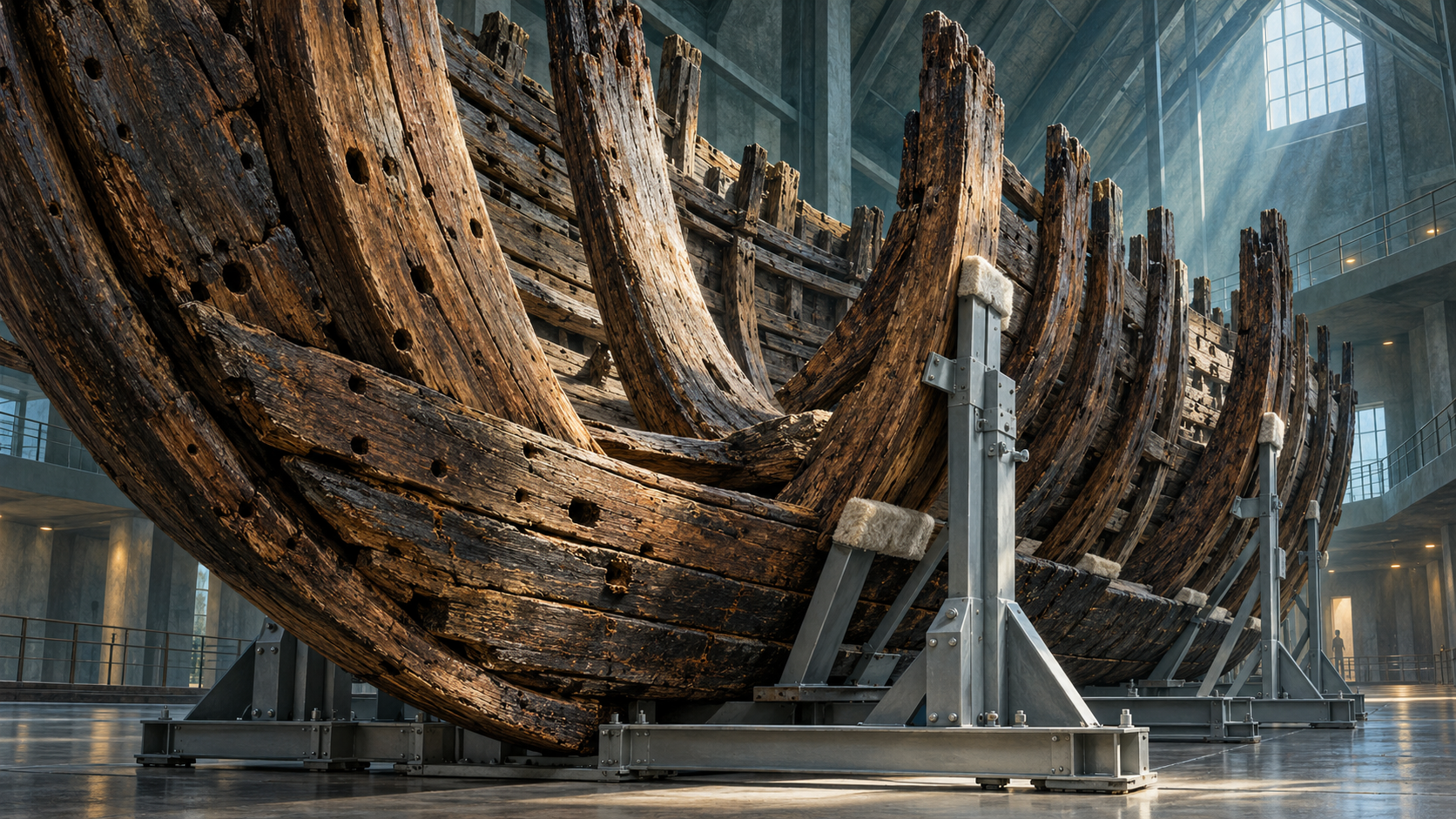
After Vasa was raised in 1961, conservators kept its hull wet while preparing treatment. They selected polyethylene glycol, or PEG, to penetrate the wood and help support its weakened structure as water was removed. The ship was sprayed with PEG from 1962 to 1979, followed by years of controlled drying. The museum's account of the original conservation also describes different treatment approaches for smaller finds.
These facts complicate the language of untouched authenticity. The ship's survival above water depended on adding a modern substance and managing an enormous transition. Conservation did not simply return it to a pre-wreck state. It created conditions under which much of the historical form could remain available for study and display.
That does not make the vessel less historically meaningful. It means that an accurate description of the object includes its treatment history. A seventeenth-century structure and a twentieth-century preservation campaign coexist materially. Trying to choose only one as the “real” object would conceal the circumstances of its continued existence.
Scale mattered. Smaller wooden objects could be treated in tanks, whereas the hull required a spray system. The museum also notes that not every wood species responded equally well and that some objects awaited the development of other methods. A treatment can be productive without being universally suitable, and the history of its use should retain that variation.
A surface symptom becomes a research problem
When the museum opened in 1990, conservation was considered complete. White and yellow deposits subsequently appeared on wooden surfaces. Investigation identified acidic sulfur and iron compounds, and research expanded from the deposits to the condition of the wood beneath. The museum's account of continuing preservation explains why visible condition alone did not capture the structural problem.
This is a particularly instructive institutional admission. Completion was a defensible milestone within one phase of work, not a permanent guarantee. New observations changed the questions. The important act was to treat the change as evidence requiring investigation rather than as an embarrassment to be concealed.
A deposit is also a misleadingly local sign. A visitor might read it as a surface-cleaning problem. The museum's response instead connected chemistry with strength and mechanical support. That connection changes the logic of intervention: removing what looks unattractive is not necessarily the same as addressing what threatens the structure.
The museum is part of the treatment
The same preservation account reports that upgrading climate control in 2004 reduced seasonal movements and the development of deposits. It describes trials of iron removal from smaller objects, while recognizing that the enormous hull cannot simply undergo the same retreatment.
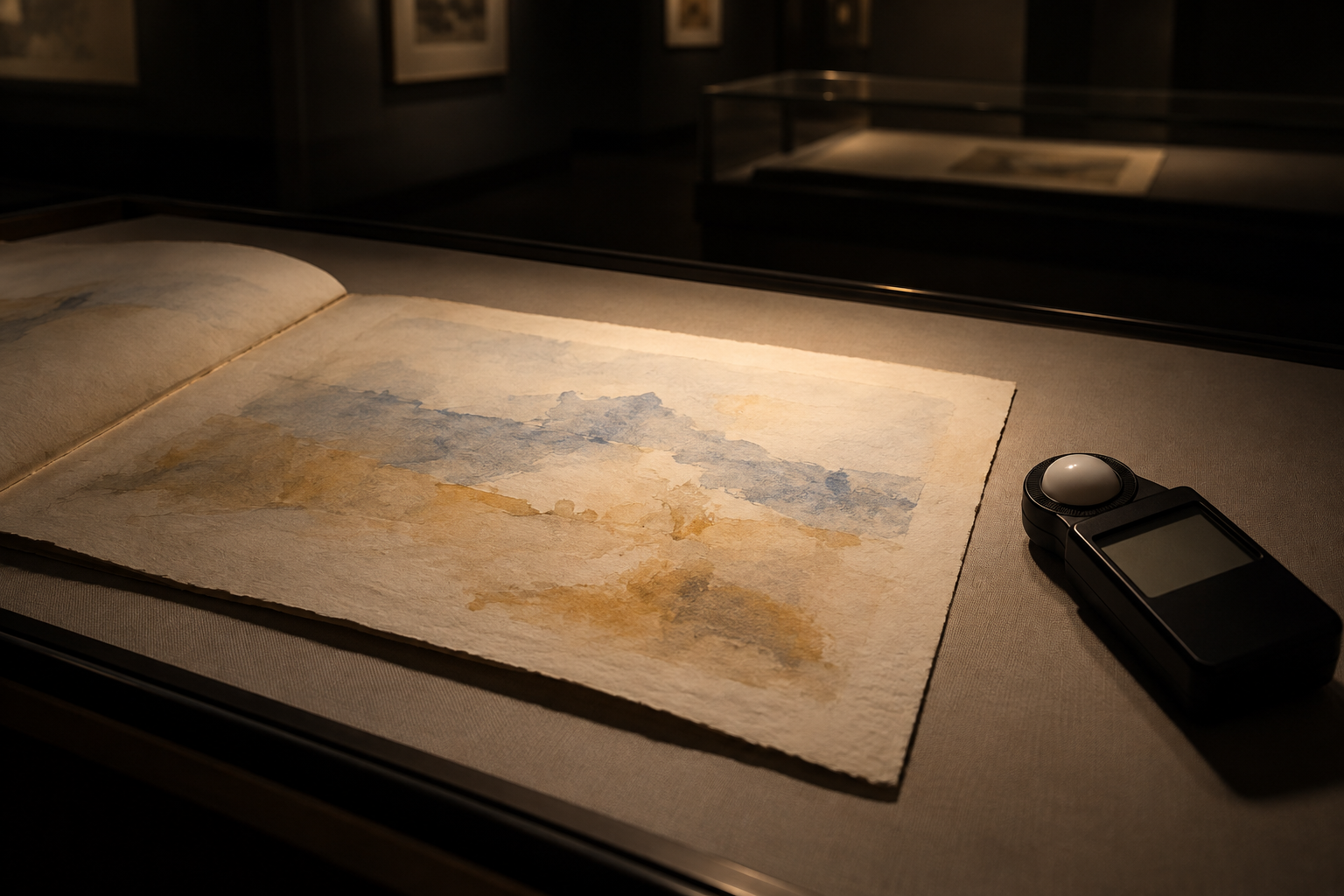
The museum building therefore belongs to the conservation system. Temperature and humidity are not a neutral background around the artifact; they help determine how it behaves. In practical terms, caring for the vessel can mean maintaining equipment and interpreting measurements at a distance from its carved surfaces.
This is why the image of a single heroic treatment is inadequate. The conservation campaign produced a manageable object under particular conditions. Maintaining those conditions is part of the result. The claim is not that the ship has become artificial, but that its continued presence depends on an explicitly managed relationship with its surroundings.
There is a useful distinction between a method that works on a sample, a treatment possible for a small find, and an intervention feasible for a complete ship. Evidence at one scale informs another without automatically transferring to it. The limits are physical and logistical as well as chemical.
Even a modern repair has an afterlife
Vasa's original iron fastenings had corroded during burial. Thousands of replacement bolts installed in the 1960s later developed corrosion and mechanical problems of their own. A subsequent project replaced roughly 5,000 bolts and was completed in 2018. The new design used corrosion-resistant steel and a more complex assembly intended to control the force exerted on the wood. The museum's bolt-project account explains both the material choice and the practical difficulties of replacement.
A repair is thus not outside history. It ages, interacts with the object, and can become the subject of another intervention. That need not make its earlier installation a mistake. A decision that makes salvage possible can require revision when the object enters a different phase of its life.
The bolt story also shows why conserving the whole can involve altering a part. Preserving every twentieth-century fastening in position would not necessarily best preserve the historical hull. The defensible choice depends on documenting the intervention, understanding its consequences, and identifying what the project is trying to sustain.
A ship held in the present tense
The museum's account of its new support system gives a planned completion date of 2028. A plan is not a completed outcome, and it should be read as such. Its significance here is the underlying recognition that chemical condition and structural support cannot be considered separately.
Vasa is often admired as something that has survived. It is more revealing to think of it as something being sustained. That wording leaves room for measurements, maintenance, uncertainty, and changed decisions. It also recognizes that the people responsible for the ship inherit obligations rather than merely a finished achievement.
The most remarkable part of the conservation story may be this willingness to reopen the question of what the object needs. Raising the vessel made it available to the public. Keeping it available requires a quieter and longer labor: noticing when old solutions reach their limits and building the next one with enough evidence to be answerable for it.
A thought worth keeping?