A face can become invisible without all of its photographic evidence disappearing. In some severely tarnished nineteenth-century daguerreotypes, researchers have recovered portraits by mapping mercury across the plate. The result is not a freshly cleaned photograph. It is a new image derived from a material distribution that survived when ordinary viewing no longer worked.
That distinction is the most interesting part of the achievement. It separates recovering information from restoring an object's appearance. Once those goals are distinguished, a damaged photograph can become readable in another form while remaining physically altered. Conservation acquires an additional option: investigate what survives before deciding what to remove.
An image made on a metal surface
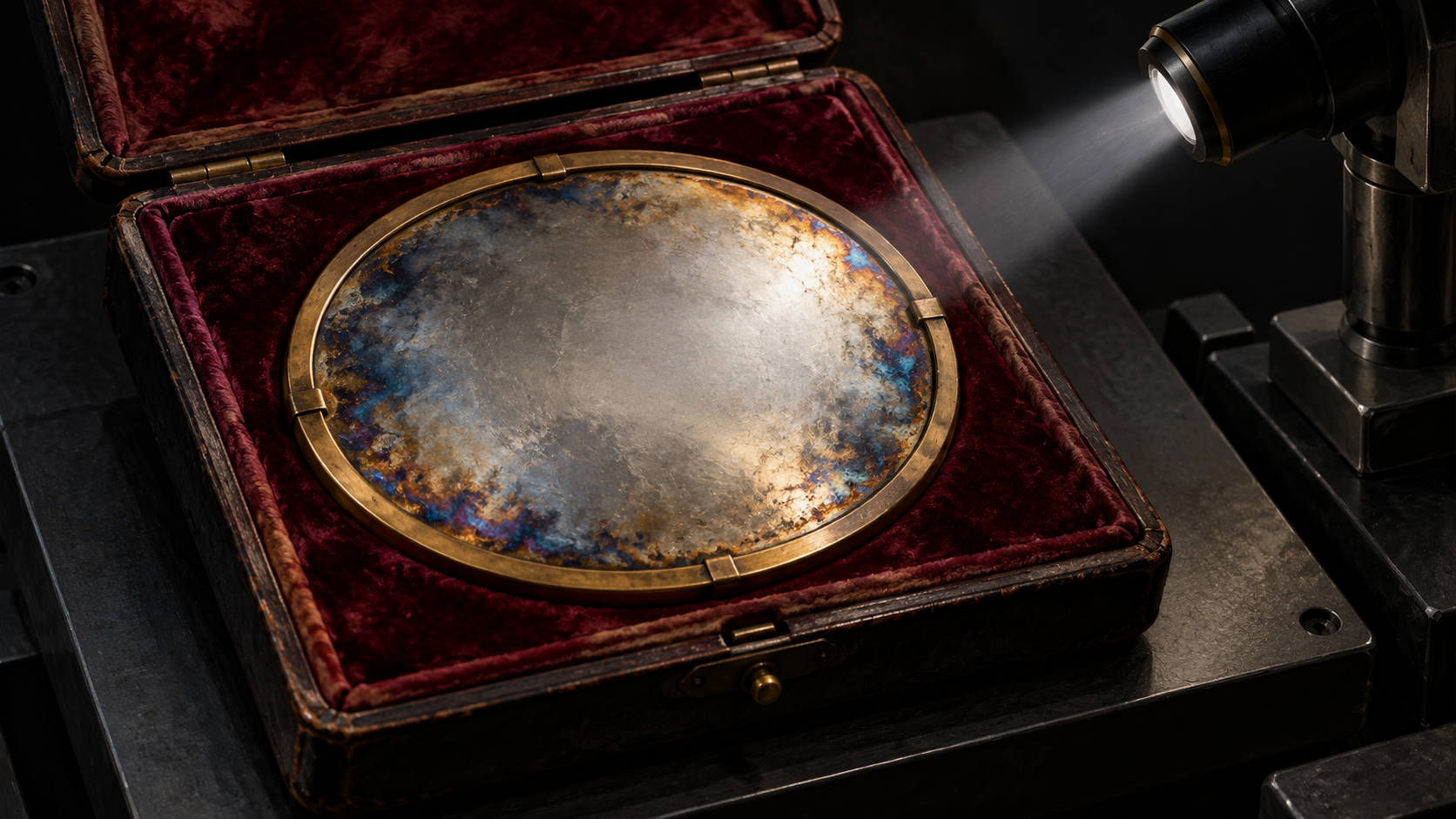
The Library of Congress describes the daguerreotype as a direct photographic image made on silver or silver-coated copper, without a negative. In the conventional process, mercury vapor developed the exposed plate. Later gilding practices increased image stability and contrast. The Library's research account of ungilded daguerreotypes explains why manufacturing differences matter to preservation.
The photograph is therefore not an image that can simply be peeled conceptually away from a generic metal backing. Surface particles, their distribution, and their interaction with light help create its appearance. A damaged surface can compromise the photograph even where the overall plate remains intact.
This also makes the word cleaning unusually consequential. A procedure that removes an unwanted substance may affect image-bearing material beside or beneath it. A viewer's reasonable wish to see a face clearly is not by itself a sufficient specification for a treatment. The physical question is what can be altered without losing evidence that another method might recover.
Tarnish is a category, not one substance
A 2018 study of a historical daguerreotype used microscopy, X-ray fluorescence, and X-ray absorption spectroscopy to characterize deterioration. Its results showed several compounds rather than one uniform coating. The authors considered possible interactions with degraded cover glass, but the original glass was unavailable for direct comparison and the object's earlier treatment history was uncertain. The study of daguerreotype tarnish keeps those limitations visible.
This matters because naming a blemish can create a false impression of understanding it. White haze, dark spots, and other features may arise through different processes. A treatment appropriate to one problem cannot be assumed to solve everything that a casual viewer calls tarnish.
The missing glass is instructive too. A protective component can enter an object's chemical history, but establishing exactly how requires evidence. The paper does not need a perfectly complete biography of the plate to contribute useful findings. It does need to distinguish measured compounds from proposed sources of those compounds.
The map that becomes a face
In a separate 2018 study, Madalena Kozachuk and colleagues used synchrotron micro-X-ray fluorescence to map mercury on badly degraded daguerreotypes from the National Gallery of Canada. Mercury's surviving distribution corresponded closely enough to the original image particles to reveal portraits obscured in ordinary optical views. The paper presents two plates in detail and explains how detector performance and signal separation made the imaging practical. The original image-recovery study provides the evidence behind the striking before-and-after comparison.
The procedure did not guess a plausible nineteenth-century face from a portrait collection. It measured a surviving material trace on the particular plate. That is an important distinction whenever an enhanced historical image appears on a screen. A reconstruction's evidential value depends on what connects the output to the object, not simply on how convincing the face looks.
Even so, a mercury map is not identical to ordinary visual experience of a daguerreotype. Its tonal representation comes from measurements and processing. It can supply access to features while recording something different from reflected visible light. Clear labels should preserve that difference instead of presenting the result as an untouched historical photograph.
“Some cases” is an important result
Cornell's CHESS facility described the work in carefully bounded terms: images could be recovered in at least some severely tarnished plates. Its explanation also discusses the difficulty of detecting small image-particle signals against the copper and silver substrate. The facility's account of the experiment connects the result with advances in detector technology.
Those qualifications prevent a useful discovery from turning into a universal promise. A plate with lost or redistributed image material presents a different problem from one whose visible appearance is obscured while a relevant distribution remains. It is reasonable to hope that a method will recover more images. It is unreasonable to assume that the word damaged describes one recoverable condition.
The work also offers a reason to retain poorly legible objects. If apparent unreadability is treated as proof of complete informational loss, the future investigation becomes impossible. Keeping a damaged object is not always justified, but visual disappointment alone is a poor measure of its remaining evidence.
Recovery is not identification
A recovered portrait still leaves historical questions. The image may show a face, clothes, jewelry, or furniture more clearly without telling us who the sitter was. Improved visibility should not become permission to invent a biography. The distance between an image and an identity must be bridged by other evidence.
That restraint does not reduce the human significance of recovery. An unknown person can remain unknown while becoming visible again. The achievement is particular enough: a material record that seemed closed has yielded details someone can study. It need not culminate in a confident name to matter.
The photograph also remains a physical object requiring care after the experiment. Information recovery does not stabilize its chemistry, repair its housing, or settle future treatment choices. The new image and the old plate now have related but distinct preservation needs.
What these studies offer is a more exact vocabulary of survival. The visible image can be obscured; a chemical distribution can persist; a measured surrogate can restore access to some features. Each proposition is narrower than a miracle and more useful than one. Together, they show how patient analysis can find a portrait where looking alone has stopped being enough.
A thought worth keeping?