An erased manuscript looks like the perfect subject for a technological rescue story. Point a remarkable camera at a damaged page; recover the lost words; restore a genius to the historical record. The Archimedes Palimpsest supplies the elements of that story, but the project's own accounts make it much more interesting. Its early images were visually impressive and insufficiently useful. Its advanced instruments depended on years of manual conservation. Its digital afterlife required decisions about coordinates and metadata that no dramatic before-and-after photograph can convey.
The real achievement was learning how to ask an old object a precise question without confusing the answer with the instrument's effects. That is a more demanding ambition than making hidden things visible.
A book with more than one claim on us
The surviving mathematical manuscript was copied in the tenth century. Its parchment was later reused for a prayer book whose colophon gives the date 13 April 1229. The project's history identifies the prayer book with Jerusalem, while acknowledging uncertainty about how the earlier manuscripts reached it. The manuscript is evidence of reuse and movement as well as a vehicle for mathematical texts. Those histories should not disappear simply because one layer has become more famous. The project's historical account explicitly marks several gaps in the object's journey.
We can value Archimedes without treating the prayer book as an unfortunate covering. Reuse is part of what made the physical object we now possess. The earlier writing and later liturgy occupy the same material resource, and interpreting one should not require pretending the other never mattered. This is an ethical argument about reading the object, rather than a claim about what its medieval maker intended.
Calling the erased writing an original also needs care. The surviving parchment is a later copy of ancient work, not a page from Archimedes' own desk. Its significance does not depend on collapsing those centuries. A copy has its own handwriting, diagrams, errors, and decisions. In this instance, transmission is the historical event that makes reading possible at all.
The disappointing spectacular image
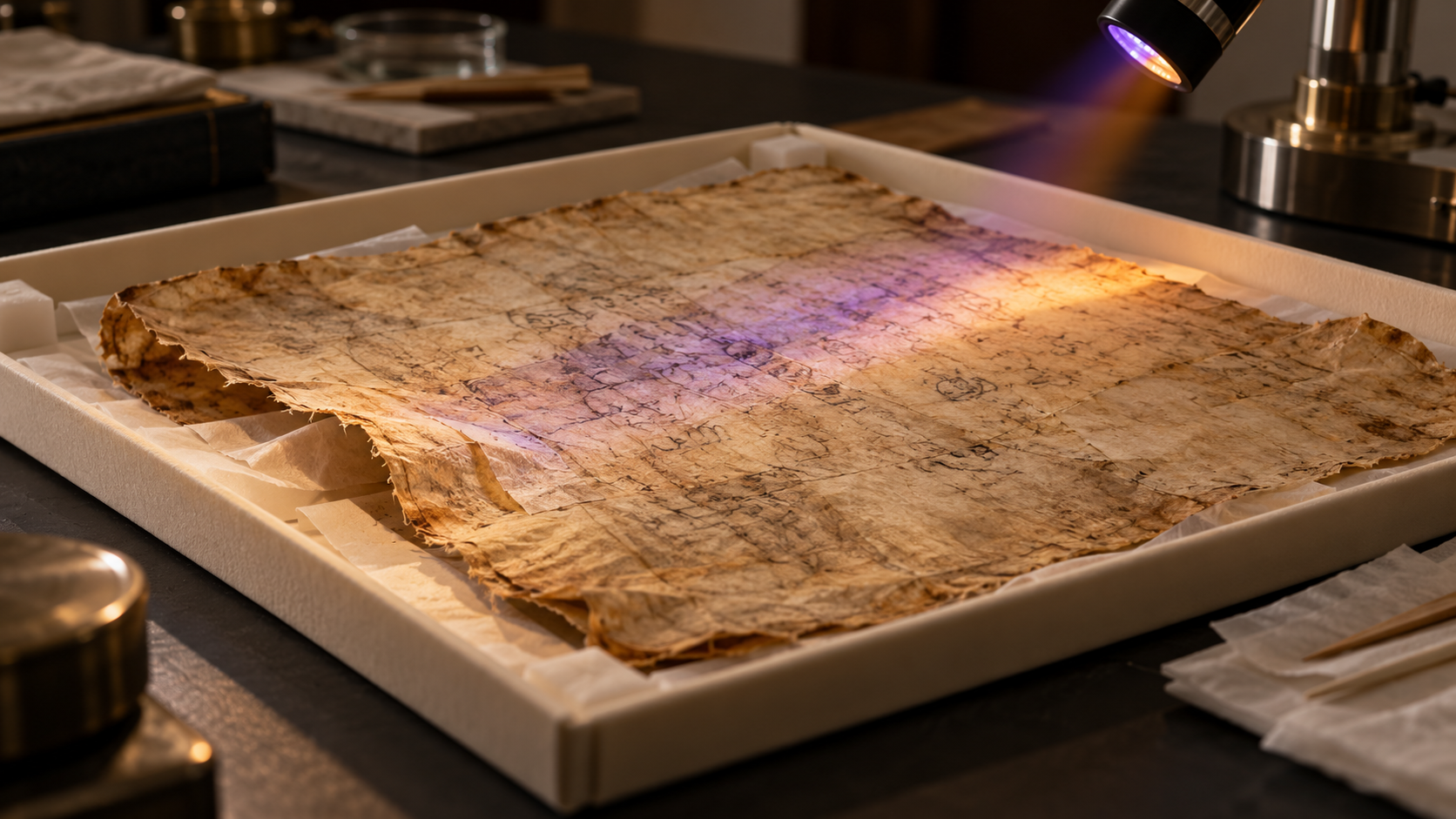
In the first multispectral experiments, researchers combined photographs taken at different wavelengths. Processing could make the later writing resemble the parchment, apparently stripping away the prayer book. Yet scholars found the results problematic. Misregistration blurred the small script; processing introduced artifacts; resolution was inadequate; and suppressing the upper writing could obscure the very overlaps the readers needed to understand. The project's imaging account records this disagreement unusually plainly.
This episode deserves to sit at the center of the story. An image can look more revelatory to a general viewer while becoming less trustworthy to a specialist. The relevant test was whether a reader could distinguish a particular letter and explain why. A successful promotional image and a successful research instrument need not be the same thing.
There is a lesson here for any cultural interface that offers automatic enhancement. A clean result can remove clues about how it was made. If a later line crosses an earlier letter, retaining both may help a reader distinguish actual evidence from a processing effect. Apparent visual simplicity can come at the expense of intellectual accountability.
Before the camera, the glue
The physical work was slow. Abigail Quandt began disbinding the manuscript in February 2000 and finished in November 2004. Modern adhesive on part of the spine proved stronger than the parchment. Individual leaves needed condition mapping, local support, and careful preparation before imaging. The project's conservation report describes damaged areas stabilized with Japanese paper and detached debris retained with documentation.
The implication is easy to overlook: a noncontact imaging method does not mean a project without physical intervention. To expose the gutter, the book had to be taken apart. To record a folded margin, a conservator might have to unfold it. The camera's apparent distance rests on other people's close, consequential handling.
Keeping debris also changes what counts as a valuable result. A removed fragment of adhesive or parchment may seem incidental to the recovered mathematics, yet it can document a treatment, an earlier repair, or the object's condition. Conservation preserves the possibility of asking questions that the current research team did not prioritize.
An element map is an argument
For difficult areas, including pages covered by modern forged paintings, the team turned to X-ray fluorescence. This records characteristic secondary X-rays from elements rather than producing an ordinary photograph. Iron mapping could reveal writing; overlapping inscriptions could produce stronger signals. Higher-intensity synchrotron work improved the practicality of the process, but potential damage to parchment required testing. These distinctions appear in the project's X-ray fluorescence explanation.
An iron map does not understand Greek. It measures a material response that a reader must interpret within a page's history. The step from signal to letter, and from letter to mathematical proposition, involves different kinds of expertise. Preserving those distinctions makes the accomplishment stronger. It identifies where measurements end and scholarly judgments begin.
It also prevents an unrealistic promise. Imaging cannot recover text from parchment that is physically missing. A method that detects residual material is constrained by what remains. More powerful machinery may answer a better question, but power alone does not dissolve every historical loss.
The quiet importance of coordinates
The project's digital documentation explains that its metadata combined Dublin Core identification with spatial approaches adapted from geospatial imaging. Transcription annotations needed to align with images; X-ray work required additional information about its different measurements. The metadata documentation makes this supporting structure visible.
That structure is a form of scholarly generosity. A processed picture becomes more useful when another researcher can locate its source region, connect it to a transcription, and understand the conditions of capture. Without those relations, a beautiful image risks becoming a detached illustration. With them, it remains an invitation to check an interpretation.
The palimpsest therefore has at least two futures to conserve: the fragile parchment and the network of evidence created around it. Neither automatically secures the other. A digital surrogate needs intelligible documentation, while the physical book retains features no chosen imaging campaign fully exhausts. The most persuasive rescue story is the one that leaves room for another reader, another instrument, and a question nobody has yet thought to ask.
A thought worth keeping?