If you want to find a blue pigment in an ancient portrait, looking only at the blue parts is a poor strategy. Egyptian blue appears in the shading of faces, pale backgrounds, whites of eyes, and mixtures that do not look blue at all. That small fact destabilizes an appealing way of imagining historical palettes: a neat row of colors, each assigned to an obvious patch of the finished picture.
Paint is more relational than that. Its ingredients cooperate, interrupt one another, and change effect with context. Modern imaging can help reconstruct those relationships, provided that we do not mistake a material map for a recovered experience of seeing.
An ingredient, not a colored territory
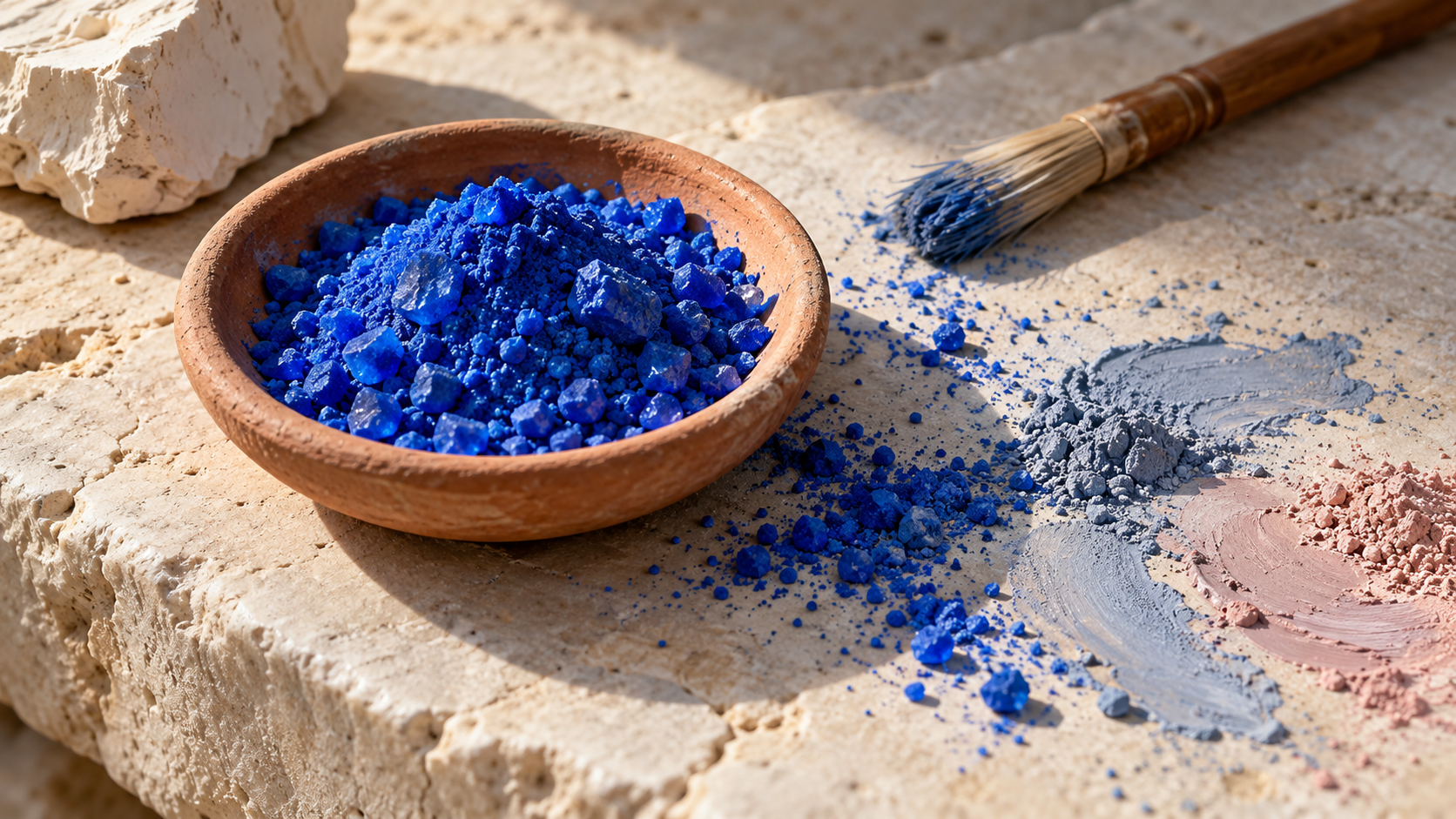
Gabrielle Thiboutot's study of Romano-Egyptian mummy portraits describes Egyptian blue as a manufactured calcium copper silicate. Her survey of APPEAR project results records frequent use in mixtures, particularly for cool flesh shading and gray backgrounds. The study's numbers belong to the database as it stood during the research, rather than to a complete census of every surviving portrait. The study of Egyptian blue in mummy portraits is especially valuable for connecting analytical findings to questions about workshop practice.
The point is not simply that ancient painters mixed colors. It is that a pigment's role cannot be inferred reliably from its name. A material called blue can participate in the production of a convincing cheek, an eye, or a muted neutral. Treating it only as a substitute for a modern blue patch would miss much of its practical importance.
There is a useful analogy with cooking, though it should not be pushed into an account of ancient intention. An ingredient need not announce itself to shape a result. Detecting it can change our understanding of the recipe without implying that the finished dish should taste like that ingredient alone. Material analysis gives us access to combinations that ordinary visual inspection may flatten.
The camera asks a different question from the eye
Egyptian blue emits near-infrared luminescence when excited with visible light. Visible-induced luminescence imaging can therefore reveal small amounts that are hard to distinguish in ordinary viewing. The technique isolates a diagnostic response rather than recreating how a portrait originally appeared. Thiboutot also cautions that images from different institutions are not automatically comparable because capture conditions and processing differ.
Those limits are conceptually important. A bright region in an analytical image should not be read as a brighter region in ancient daily life. The image establishes a relationship between a material and a measurement setup. It can identify a distribution while leaving open questions about concentration, mixtures, surface change, and original visual effect.
For a reader of museum imagery, the most useful habit is to ask what the image encodes. Is brightness showing reflected infrared radiation, emitted luminescence, or the presence of an element? Images that share a monochrome appearance may record very different phenomena. Their resemblance on a screen is not evidence that they answer the same question.
Blue is not one analytical problem
A separate study of indigo in funerary portraits tested multiband reflectance image subtraction. Its authors explored a method for highlighting indigo's behavior while acknowledging interference from other materials and the value of complementary analysis. Egyptian blue and indigo can both enter a historical palette while posing different identification problems. The experimental indigo study makes the importance of controls and material specificity clear.
This argues against the fantasy of a single scanner that simply names everything in a painting. Methods are selective. Their strengths emerge from particular optical or chemical properties, and a good study explains where another material might produce a confusing response. The absence of an easy signal is therefore not permission to declare that a colorant was absent.
That is also why reproducing a museum's analytical photograph with improvised equipment would not necessarily reproduce its conclusion. A measurement includes its illumination, filters, references, and interpretation. The visible apparatus is part of the evidence, even when it falls outside the published crop.
A discovered brushstroke can remain unidentified
Research at the Penn Museum, Getty, and Museum of Fine Arts, Boston revealed previously unobserved fluorescent brushstrokes in three portraits under specific narrow bands of visible light. Their behavior suggested a possible madder-based material, but the authors could not confirm all the relevant material and layer relationships. Their study of invisible brushstrokes carefully preserves that uncertainty.
This is a particularly good example of discovery without premature closure. Something can be reproducibly visible under specified conditions while its composition or function remains unsettled. A mark might relate to planning, modeling, or another stage of work; the question requires evidence beyond the excitement of first seeing it.
The restraint improves the historical story. It leaves an actual research problem in view instead of supplying a fictional certainty about a painter's intentions. We are allowed to know more than we did yesterday without knowing everything that the new image invites us to ask.
When the missing blue changes an attribution
At the Getty Villa, a survey found characteristic Egyptian-blue luminescence in eleven of twelve displayed wall paintings, but not in the peacock painting then considered Roman. Further analytical and historical work identified modern pigments and led researchers to conclude that the painting was modern. A possible connection with an English house remains a historical reconstruction with acknowledged gaps. The Getty Peacock investigation is explicit about both the firm material conclusion and the less certain route of the object's travels.
The sequence matters. A missing expected response prompted investigation; it did not, by itself, prove the object modern. Independent evidence had to do that work. Absence became a useful question rather than a shortcut to a verdict.
Together, these studies make Egyptian blue interesting for reasons beyond its age or beauty. It can reveal that a seemingly simple palette is materially complex. It can expose how much a measurement depends on its conditions. It can unsettle an attribution while remaining unable to tell the complete story of an object's movement. The richest history of a color begins when we stop asking only where it looks blue and start asking what, exactly, the evidence allows us to see.
A thought worth keeping?